All About Marie

Animal Files columnist of the Orange County Register from 1992-2016; Emmy Award winning producer of Educational Television Programming; Host of "The Pet Place Radio Show" heard world-wide at www.blogtalkradio.com/petplace; click the player below to listen. Producer/Director/Editor/Co-host of "The Pet Place TV Show" during the 19 years it ran on KDOC TV in Los Angeles and Orange Counties; Wife, Mother of five kids, Grandmother of two baby boys and one baby girl, and pet parent of two cats, one dog, many fish, and a cockatoo.

Listen To The Pet Place Radio Show with Marie Hulett

Thursday, March 24, 2016

Update Your Pets' Michrchips!!!


Not too long ago, a big, handsome, “senior” Labrador Retriever was found roaming the streets of Orange County.  A Good Samaritan rescued the dog from the dangerous situation, and temporarily brought him to his house.  During this time, he noticed that the Lab barked in what he considered an aggressive manner when other dogs were near, so when he took the dog to the animal shelter, he indicated to the staff that he had observed this behavior.  As a consequence, the dog was labeled “aggressive” and would not be placed up for adoption if the owner was not located.

But there was good news!  The big, yellow, smiling Labrador had a microchip!  The shelter’s office staff was thrilled and attempted to get contact information, but found that there were three different “owners” connected to the chip—one was the puppy mill where the dog was bred, the other two “owners” did not respond to calls or letters. 

For ten days the dog sat, confined only to his kennel because he had been labeled “aggressive.”  He watched, cold and alone, as other dogs were taken out for walks, pet by volunteers and potential adopters, or retrieved by owners.  No one came for him.

The shelter staff slated him for euthanasia on the eleventh day. 

Enter Labs & More Rescue.  A volunteer from this organization (a self-described pushover for big, goofy, yellow Labs) had originally seen the dog—who she named “Barney”—a few days earlier.  Even though the shelter staff had advised her that the dog was too aggressive to be placed, something told her that Barney needed her help; so she went back to the shelter. He was rescued just in the nick of time.

Volunteers from Labs & More assessed Barney’s behavior and found nothing of major concern.  They also had him vet-checked and discovered he had a number of age-related conditions, but not anything serious.  They began promoting him on their website, http://www.labsandmore.org, and took him to an adoption event; as a senior dog, it was going to be a difficult project to find him a new family.

But then Labs & More got a call from someone who had seen “Barney” on the website.  The person identified himself as the dog’s owner!  He explained that there had been a family emergency which required travel away from home.  The dog, whose real name is “Pepe,” was left in the care of a neighbor.  During the family’s time away, strong winds blew open their gate and the caretaker failed to search for the lost dog nor inform the family of the incident. 

Needless to say, they were horrified when they returned home and began checking shelters, with no luck.  Fortunately, someone suggested they check rescue websites, and that’s when they saw a picture of a dog that looked like Pepe on the Labs and More website!

They met with the volunteers who were fostering the dog, presented documentation to prove ownership, including the matching microchip number and photos, but the most obvious proof came when Pepe saw his people.  He was one excited dog and was happily reunited with his family which included a young boy who was clearly his best friend! 

Though this story has a happy ending, it could have ended terribly.  There are several lessons here.  First, if your pet is microchipped, make sure you have updated emergency contact information in the microchip company’s database.  That way, if you are out of town, an alternate person(s) can be contacted to help.  Second, always keep a collar and I.D. tag on your pet that is engraved with your cell phone, or other emergency number.  Had Pepe been wearing a tag with a phone number, he would never have been taken to the shelter in the first place.  Finally, NEVER leave your pet in the care of someone that isn’t completely trustworthy and responsible. 


To conclude this tale, I leave you with this thought—Labs & More, and rescue volunteers everywhere are the heroes of this tale.  They tirelessly work to save pets in shelters and they deserve huge thanks from all of us who care about animals.   

Friday, March 4, 2016

Food Aggression in Dogs


Dear Marie:
I have adopted a Tibetan Spaniel who is, for the most part, a very sweet dog.  Unfortunately, he gets very possessive around his food dish and shoves my other two dogs, a Shih Tzu and a Pomeranian, away from the food.  He’ll even steal their treats and is always ready to fight.  I would like for them to get along and not have to separate them at feeding or treat time.  What can I do?

Rita

Dear Rita:
There are a number of things you can try; but if there is a possibility that your other dogs can be injured during the time it takes to train him, it may be best to feed him in another room with the door closed or outside.  You can even feed your two mild-mannered dogs in a different room with the door closed.  As long as they have a separate location, it's all good.  Use your discretion in that regard.

In the wild, dogs have a definite hierarchy which determines who eats first and who gets the best of the meal.  The alpha dogs always eat first and will definitely bear teeth and bite any other dog that attempts to “dine” at the same time.  Your Tibetan Spaniel seems to think he is the “alpha” of your pack.  If you have not had him neutered, do so immediately.  That should make a big difference in his “top dog” attitude.

When you offer dog treats, put a leash on your aggressor.  If he tries to act out towards your other two, immediately walk him away from the other two dogs and give him a command to sit our lay down.  When he does, praise him and give him a treat.  You can also use the leash method when feeding the three of them together.  By redirecting his focus to the fact that you are the one in charge and that you only approve of good behavior, he will slowly begin to be more tolerant of the other dogs.

Additionally, you should take his food away each and every time he acts.  As soon as he settles down, you may give him back his food.  Of course, he does need to be on a leash or he will just go into the bowls of his housemates, so be sure to keep him away from their dishes. 

Some dogs need space to feel comfortable while eating. It's a good idea to have each dog's food bowl a reasonable distance away from the other bowls.  Furthermore, if he tries to steal treats from the other dogs, don’t reward him by giving him his own treat. 

Experiment with training.  Fill up his food bowl and have him sit and wait until you give him the command to have his meal.  To do this, put him in "down-stay" or "Sit-stay."  (If you haven't mastered these yet, please begin basic training as soon as possible.) Place the food bowl about three feet in front of him.  He will immediately go for it.  You will need to pick up the food bowl and put him back into his down-stay position.  Once he realizes he has to wait, and follows your voice command, then you can allow him to come eat.  By completing this type of training, you are taking away his food dominance and that is really important with food aggression.

The moment he shows improved behavior, lavish him with praise.  Give him the chance to be successful.  Any progress should be rewarded in one way or another.  It will take some time; but with consistency and repetition his behavior will turn around.


Thursday, March 3, 2016

Whining Cat


Dear Marie,
Help!  I have a sweet, elderly cat with a thyroid problem.  She is probably 17 or 18 as I don't know her background since she came from a shelter.  I cannot go near the kitchen or she is right there meowing for food.  Not only that, she has become very selective in her food, and I find myself throwing a lot of food away.  I guess my question is—is it possible to correct this whining?  Is she really hungry or is she wanting attention?  She also prefers to drink her water from a faucet which is creating problems during the water shortage as sometimes the running faucet is overlooked.  I love her dearly and want her remaining time with me to be happy but this whining (along with the other problems) is driving me crazy.

Shirley

Dear Shirley,
As cats get older, they tend to become more vocal.  Part of this is due to the fact that their hearing has deteriorated so they don’t realize how loud, and perhaps obnoxious, they are being.  But the crying may be health related. 

I am assuming that since you know your cat has a thyroid problem, that she is under veterinary care and she takes medication, or has the appropriate treatment to keep her condition under control.  If not, please schedule a vet visit as soon as possible.  Your veterinarian will be able to determine exactly what she needs based on a blood test.  Once your kitty’s thyroid problem is properly managed, she will not feel chronically hungry.

Most cats do get a little more finicky with advancing years.  For senior citizen pets, some foods are very difficult to digest and cause stomach upset.  It’s probably time to look into foods specifically designed for the more sensitive stomach of your aging feline. 

Kitties do seem to want more attention as they enter their sunset years.  Their bodies are noticeably failing.  They feel a little less secure.  You are the individual who has been a source of comfort throughout your cat’s life in your home.  You are her rock.  Try to be patient and not let her vocalizations annoy you.  Instead, spend a little extra time with her, especially knowing that whatever time she has remaining is limited.  You will miss her, and her extra loud meowing once it is silenced.

Many cats enjoy drinking fresh, running water.  Some are captivated by the motion and the sound.  I think it may spark an ancient, instinctual memory and makes them feel like a creature of the wild who has discovered a hidden stream.  (That might just be my own imagination running wild!)  In any case, just being next to a stream of fresh water encourages a cat to drink more and this is especially important for older cats.

Like all her other body systems that are wearing out, your cat’s kidney function is most likely beginning to wane.  Drinking extra water during this phase of life helps keep an old set of kidneys functioning well.  But instead of leaving a tap turned on, check out some of the special drinking fountains that are created just for cats who love running water.  You can probably find a few at your local pet supply store, or try an Internet search using the search criteria, “drinking fountains for cats.”  You can find quite a few different models online at very reasonable prices.  There are also reviews of many of the fountains posted by consumers who have purchased these items for their own cats.


I have no doubt that your kitty’s remaining time with you will be happy.  Do your best to muster up a little extra patience.  The final months to years of a pet’s life are sometimes difficult to handle for a lot of reasons.  But if loud meowing, finicky palate, and asking for more attention are the worst of your cat’s symptoms of aging, you are doing pretty well.  

Wednesday, March 2, 2016

Salt Water Aquariums


Dear Marie,
We recently visited the Aquarium of the Pacific in Long Beach and were inspired to start a salt-water aquarium for our home.  Our friends think we’re crazy and have told us that there is way too much work and effort involved and the fish will probably all die.  They also said everything is quite expensive.  Are salt-water aquariums really that hard to manage? 
Sally and Ed

Dear Sally and Ed,
Salt-water aquariums can be a bit of a challenge and I won’t tell you that this endeavor is going to be cheap.  But, if you are committed to the project and are willing to put some time and effort into research before you get started, you will be very pleased with your results once your tank is established.

First, you will need to decide what type of fish you would like to have.  There are many different species of salt-water dwelling fish and you will need to learn which ones can live together peacefully, and whether or not they are cold water or tropical fish.  You can either hit the books at your local library, or talk to one of the experts at the store where you plan to purchase your little critters.

It takes about a month to get a salt-water tank ready for living creatures.  Start by getting a tank that holds at least thirty gallons of water.  For salt-water aquariums, the bigger, the better.  Clean the interior surfaces thoroughly using plain water with clean paper towels. 

Find a secure location to place your tank.  Keep in mind that California is earthquake country and look for a spot that will be protected from falling objects.  You should also position your aquarium away from windows.  Generally, it’s a good idea to brace tanks against good, strong walls on stands made specifically to support the heavy weight of all the water.

You’ll need to purchase aquarium gravel.  The bottom of your tank should be covered with about a two-inch thick carpet of these small pebbles of crushed coral or dolomite.  You will probably also enjoy adding decorative aquarium rocks and corals so that your fish will have places to hide and explore.

Once you have your tank decorated to your liking, and you can get very creative if you want, it’s time to add water and a filter.  There are many different types of filters available and their costs vary.  Again, talk to the people at the store where you will be purchasing fish to find out what type of filter would be best for the species you plan on having. 

Obviously, saltwater won’t come out of the kitchen sink, and you definitely do not want to add table salt to solve this problem or you will have a deadly outcome.  Instead, you must purchase a special salt mixture from your pet supply store and add it according to labeling instructions.   The mixture should contain a little calcium or you can purchase this separately.  Once you have the aquarium filled, water and salt mixed and the filter running, you will need to monitor the tank’s pH, water temperature, alkalinity, and nitrate content.   In about 4 weeks, you should notice that everything has stabilized within the acceptable levels for your fish.  If it has not, please do not rush the process.  Wait until your tank is ready before placing any fish inside.

Salt-water fish are very pricey.  You should probably begin with the least expensive fish you can find because as careful as you may have been in setting up everything, there may still be a few problems and you will most likely lose a few individuals in your first few weeks.  However, once your tank seems to be thriving, you may begin adding some of the more spectacular salt-water fish.

Different species of fish require different diets.  Again, it is important to find out what your selected fish will require to be healthy and happy.

You will need to clean your aquarium from time to time.  Most experts agree that you should only replace some of the water at regular time intervals and use various cleaning tools to eliminate algae growth. 


Salt-water aquariums are indeed a lot of work.  Nevertheless, if you truly enjoy the beautiful creatures they house, the time and expense definitely pay off.

Monday, February 29, 2016

Second Hand Smoke is BAD for pets!

Dear Marie,
My roommate of 4 years has a new boyfriend (2 months) who is a smoker.  Because she is such a good roommate and always has her half of the rent on time, I overlook small problems that come up every now and then.  But I think I made a mistake by saying it was OK if her boyfriend smoked inside our home, and now I’m regretting it in a big way because he is here all the time…smoking!  I have a parakeet, a cat, and a small dog and they all seem to be suffering.  It may just be my imagination or coincidence, but since he came into the picture, it seems like my pets are sneezy, have runny eyes, are lethargic, and even have episodes diarrhea.  I don’t want to seem like I’m complaining, but I don’t want anything to happen to my pets either.  We only have a two-bedroom apartment and sometimes it’s so smoky inside, I think I’m walking through London Fog!  What should I do?
Sheila

Dear Sheila,
I understand that good roommates are hard to find, but if she is as good as you say, she will understand if you tell her that you would like her boyfriend to only smoke outside.  If he is a decent guy, he’ll understand too.  If they give you a hard time about this, it may be time to find a new roommate. 

The fact is secondhand smoke is a serious health hazard for your pets AND YOU!  There is no reason that you should live under this condition.

But let’s just examine this issue from the animal health perspective.  Here are the facts.  Cats who are exposed to cigarette smoke are three times more likely to develop lymphoma as cats who don’t live with smokers.  Because cats groom themselves with their tongues, they ingest all the chemicals from the smoke that has settled onto and into their fur.  Essentially, they are getting a double dose of poison: one from just trying to breathe, and the other from grooming.   

Cats, like many humans, tend to be more likely to develop asthma if they are subjected to secondhand smoke.  And it is not uncommon to see chronic bronchitis in dogs that live with smokers.  Dogs who live in cigarette-smoke-filled homes also have a much higher risk of developing nasal tumors—especially dogs with long snouts—due to increased interior surface area on which carcinogens cling and wreak havoc.  Sadly, once diagnosed, dogs with nasal cancer usually don’t live beyond a year.

Of course, pets of all species are at risk of developing lung cancer, severe respiratory problems, cardiac abnormalities, eye irritation, diarrhea, vomiting, and other health maladies associated with the hundreds of chemicals and toxins that come from tobacco smoke. 

If you have a pet that likes to eat nonfood items that he finds on the floor, you should know that cigarette filters and butts are extremely toxic.  A small or very young animal that eats as few as two cigarette butts can die within a very short amount of time from the point of ingestion of these hazardous discards.

For bird owners, secondhand smoke is particularly dangerous as birds are far more susceptible to airborne toxins and carcinogens than other animals.  They may rapidly develop life-threatening respiratory problems.  Some birds begin feather plucking after exposure to secondhand smoke, which if left unchecked, will damage feather follicles to the point where no new feathers will ever grow again.  Heart disease, eye problems, and lung cancer in birds are all very real consequences stemming from living with a smoker.

Even if your roommate’s boyfriend smokes outside, you should immediately invest in a high quality air purifier.  This will reduce some of the hazardous chemicals that are stuck in your walls, carpet, furniture, etc.  Also, ventilate your home as much as possible. 


There has been some talk about “third-hand smoke” which amounts to the toxins that cling to a smoker’s hair, clothes, etc.  If your pets cuddle with your roommate’s boyfriend, they may be exposed to harmful contaminants.  Depending on how far you want to go with safety precautions, you may need to put your pets into your bedroom whenever the boyfriend comes over.  But, if he is over “all the time” as you mentioned, then it may just be time to move on and find a new place and/or a new roommate.  It may be hard to break the news, but honestly, it’s so much harder to see a beloved pet die from a preventable disease.

Wednesday, February 10, 2016

Owner of Outdoor Cat Neglects Care and Responsibility


Dear Marie,
Our neighbor claims to “own” a cat that wanders throughout the neighborhood and frequently spends time at our house.  As far as I can tell, the cat is never allowed into the home of the “owner” and is outside during the coldest of nights.  We have been giving it food and water for at least three years and have taken it into the vet on numerous occasions when it has been injured in cat fights.  When it is particularly cold or rainy outside, we usually let him come in our garage and keep a box filled with blankets in there for him.  One of the reasons we did this was that we were never certain that the cat even had a home.  Last month, we took him to the vet to be neutered because he had fathered dozens of kittens in our neighborhood.  (There are a lot of stray cats here.)  His owner has never taken any kind of responsibility with him.  When she found out that we had had him neutered, she was furious.  She came over and threatened to call the police.  She told us not to bring him in our house anymore or give him food.  Yet she continues to leave him outdoors and I don’t even know if she feeds him.  I have never seen a food or water dish outside for him.  The cat keeps coming over to our front door and begging for food and he is getting skinnier and skinnier.  It is breaking my heart.  What can I do?  
Marta,
Stanton

Dear Marta,
I am sad to report that many cat owners treat their pets exactly as your neighbor does hers.  In the minds of many, cats don’t need much care, and to a large extent, they are left to fend for themselves.  And yet when kind neighbors (such as yourself) attempt to provide a little love and compassion, their only reward is anger and threats on the part of the self-proclaimed cat owners.

There are a couple of things you can do in this situation.

First, you can talk to the owner and let her know that you weren’t sure if the cat indeed had a home and that is why you were providing various forms of care.  Let her know that you are very fond of the cat and would assist her in any way with care and feeding.  It may just be that she is financially unable to provide for her pet and is feeling embarrassed about the situation.  Often, embarrassment causes people to act out angrily in a situation like this.  Let her know that neighbors are supposed to help neighbors and that you’d like to wipe the slate clean and be friends.  If you are successful in this endeavor, you may be able to give her some tips on cat care and ultimately steer her down the path to becoming a responsible pet owner. 

Chances are, this won’t work.  People tend to be too proud to work things out, as unfortunate as that seems to be.  So the next option I offer to you is the law.  An Orange County Codified Ordinance very specifically states that no pet may wander onto any private property without the expressed permission of the property owner.  Your neighbor’s cat is obviously still roaming the neighborhood, which is a violation of this law.  Therefore, you may legally trap the cat and take it over to the Animal Shelter.

I am assuming that you would be willing to adopt this animal and make him your own.  If this is the case, be sure to fill out a “hold form” to let the shelter’s staff know that you intend to adopt this kitty if its owners do not come to claim him.

Since your neighbor has provided the bare minimum of care for her cat – and even that is questionable, I doubt that she will redeem him.  Once the shelter has held the cat for the legally mandated number of days, you may officially adopt him and will be his rightful owner from that day forward.

I would strongly recommend keeping him indoors for the rest of his life – not only because this is the best way to care for a cat, but it will also keep him away from his previous owners who may still think that the cat is theirs.


If you do choose to turn the cat in and then adopt it, you may end up with a nasty neighborhood dispute, complete with the police knocking at your door.  Be sure and keep all of your adoption papers from the shelter, as they will prove that you are the legal owner.  Whatever you decide, I wish you – and the cat – all the best.

Monday, January 4, 2016

Preparing for El Niño - A Guide for Pet Parents


For California, El Niño is finally here and hopefully all you pet parents have prepared properly!  (Say THAT three times fast!)

If you haven't, then it's time to get with it!

First and foremost - have your emergency pet packs prepared in case you need to evacuate your home.  These are the same items you would use for earthquakes or any other disaster preparedness pack.  Many homes in California are in danger of being flooded or are in land slide locations.  This is a serious issue and you MUST be prepared to leave on a moment's notice.  This means you should have ID tags on each and every one of your pets.  Microchips are important too since tags can be lost.

Have collapsible dog crates, food, bowls, bottled water, leashes, harnesses (even for cats), license and vaccination paperwork loaded in your car.  If you pet takes medicine each day, add extra prescription medicine for these pets into your emergency pack.  The phone numbers for your regular veterinarian and emergency veterinarian secured on every pet crate, along with your cell phone number and contact info (and emergency person contact info).  That way, if you need to leave your pet at a shelter, they will have that information.  It's best to put your cell phone number on your pets' tags in addition to your home number AND the number of your emergency contact person who lives out of the area (and presumably in a safe location).

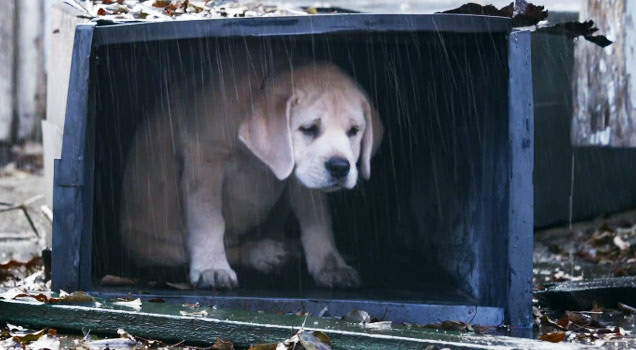
DO NOT leave pets outside during storms!  Even if you have dog houses! Cats should be indoors anyway, but if you are one of those people who still lets your cat roam, at least bring it in for the storm season.  They will get drenched and will become susceptible to upper respiratory infections.  (How would you like being cold, wet, and sick because you are locked out of your family home?)  Dogs also need to be indoors.  Rain is frequently accompanied by wind.  If there is heavy enough rain and strong enough winds, fences, and trees WILL blow down, allowing your pet to escape.  And I'll say again...how would you like being cold, wet, and locked out of your home?

For horse and livestock people, make sure your animals have a dry place to go.  Add sandbags or other sealing material to the outside perimeter of their barn or other enclosure.  Cover with fresh straw/hay/bedding material and clean/change regularly.  Don't let food get rained on and if it does get damp, make sure to clean/dry the receptacle so that it does not get moldy or start growing another fungus.  Check your fence-lines DAILY!  Be prepared to evacuate your livestock to a safe place if you live in a landslide, mud-flow, flooding area.

Finally, consider fostering the pet of a homeless person during storms.  They cannot take pets to temporary homeless shelters and will often remain unsheltered themselves so that they do not lose their pets.  We all see these people and their pets throughout the year and hopefully we have all been showing them kindness by providing blankets, food, etc., all year long.  So if you see them, HELP them by offering to care for their pets.